
Texas OC (Pepper Spray) Certification — Part 1, 100% Online
In Texas a chemical dispensing device is a prohibited weapon. This is the training that gives a security officer the legal defense to carry one.
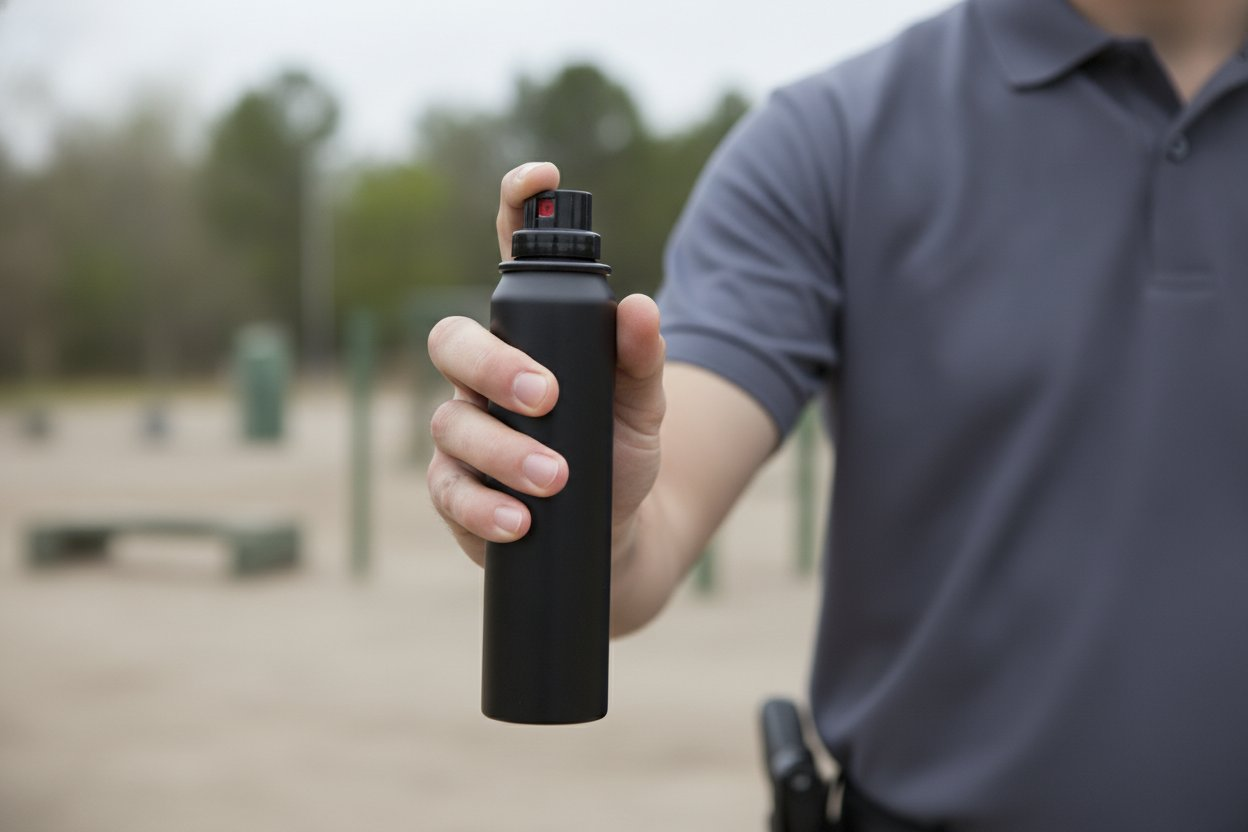
Why this certification actually matters
Most people assume pepper spray training is a nice-to-have. In Texas it is a legal issue. Under Texas Penal Code §46.05, a chemical dispensing device is a prohibited weapon. The statute then provides a defense to prosecution:
"It is a defense to prosecution under this section for the possession of a chemical dispensing device that the actor is a security officer and has received training on the use of the chemical dispensing device by a training program that is: (1) provided by the Texas Commission on Law Enforcement; or (2) approved for the purposes described by this subsection by the Texas Private Security Board."
That is what this course is. Without current, approved training, a security officer carrying a duty-size OC device does not have that defense available.
Two points of precision. First, §46.01(14) defines a chemical dispensing device as one "other than a small chemical dispenser sold commercially for personal protection" — the keychain spray sold at a store is not a prohibited weapon. This is about the duty-size devices officers actually carry. Second, §46.05(g) states that for this defense "security officer" means either a commissioned security officer under Occupations Code §1702.002 or a noncommissioned security officer registered under §1702.221. So the Penal Code itself does not shut out non-commissioned officers — the Level III requirement below comes from how the Texas Private Security Board approves this course, not from the statute.
You need Level III first — this is not optional
The Texas Private Security Board has approved pepper spray training as a supplement to the Level III curriculum, and DPS is explicit about the consequence: the Pepper Spray Training is approved only for those who have successfully completed Level III training.
The reasoning is sound. Level III’s defensive tactics and use of force units are what tell you when deploying the device is appropriate and lawful in the first place. Without that background the certificate does not mean much.
So: if you hold a Level II licence only, this course is not yet approved for you. Start with Level III Part 1 and come back. If you are unsure where you stand, ask us before you pay — we would rather tell you than sell you the wrong course.
Already had pepper spray training years ago?
Then you probably need to take it again. The older curriculum has been superseded and is no longer approved by the Private Security Board, and DPS will not reissue a certificate for training completed under the old material. For the §46.05 defense, what counts is the currently approved training.
Good news for commissioned officers: you do not have to repeat Level III to get the pepper spray certificate. Having completed Level III previously is enough.
You will not be sprayed
Exposure is at the instructor’s discretion and is not required to pass the course. We do not spray students.
What the online portion covers
- What OC actually is — Oleoresin Capsicum, derived from hot peppers, and the capsaicinoids that do the work. It is an inflammatory agent, which behaves differently from the older CS and CN chemical agents.
- Effects — involuntary eye closure, uncontrollable coughing, loss of strength and coordination, plus the psychological side: panic, a collapsed will to fight, auditory exclusion. Effects vary by person, which is exactly why you monitor a subject afterwards.
- Deployment — drawing from low-ready, verbalising "STOP!" when it is tactically safe to, targeting the eyes, nose and mouth, and the spray patterns: criss-cross, serpentine, circle, low-to-high, side-to-side. A burst is half a second to a second, not a sustained stream.
- Distance — a minimum of 3 feet and a maximum effective range of roughly 15 feet. Closer than 3 feet risks eye injury from the hydraulic needle effect and sprays you along with the subject.
- Decontamination and aftercare — fresh air, cool water, remove contaminated clothing. No creams, salves or lotions. Do not remove contact lenses unless trained. Re-evaluate the subject at least 45 minutes after exposure.
- Medical red flags — recognising excited delirium and neuroleptic malignant syndrome, both of which can end in sudden death. If you suspect either, you get EMS moving immediately.
- Liability — where officers get themselves and their employers sued: unnecessary or punitive use, excessive dosage, no training on file, delayed first aid, and failing to monitor the subject afterwards.
Then Part 2 — and it is quick
After the online portion you attend a short in-person Part 2 covering the practical draw, target and deployment. It usually takes five to ten minutes. It is booked separately and costs $9.99.
Price: $29.99 — online Part 1 only
Full OC certification comes to $39.98 — $29.99 online plus the $9.99 in-person session. You receive a separate Pepper Spray training certificate on completion, distinct from your Level III certificate.
Common questions
Do I need Level III before taking this?
Yes. The Private Security Board approved this training as a supplement to Level III, and it is approved only for officers who have completed Level III. A Level II licence on its own is not enough.
Will I get sprayed?
No. Using live targets and spraying students is at the instructor’s discretion and is not required to pass. We do not do it.
Do I have to retake Level III to get the pepper spray certificate?
No. If you have already completed board-approved Level III training, the pepper spray course can be taken on its own as a supplement.
I did pepper spray training years ago. Does it still count?
Probably not. The earlier curriculum has been superseded and is no longer board-approved, and DPS will not issue a current certificate for it. For the Penal Code §46.05 defense you need the currently approved training.
Does this let me carry a firearm?
No. This certificate covers a chemical dispensing device only. Carrying a firearm on duty requires Level III plus a Security Officer Commission from the Texas DPS Regulatory Services Division.
How close is too close?
Under 3 feet. At that range the stream can injure the eye through the hydraulic needle effect, and you will likely contaminate yourself as well. Effective range runs out to about 15 feet.
More questions? See the full FAQ or browse all ETXSTA courses. OC is also included in the Security Career Fastrack, which sequences Level III ahead of it for you.